Showing posts with label Ray Bradbury. Show all posts

Saturday, November 16, 2013

Gratitude

Thanks to StoryDam for suggesting this prompt. Ten minutes on the topic of gratitude, and what the idea means to us.

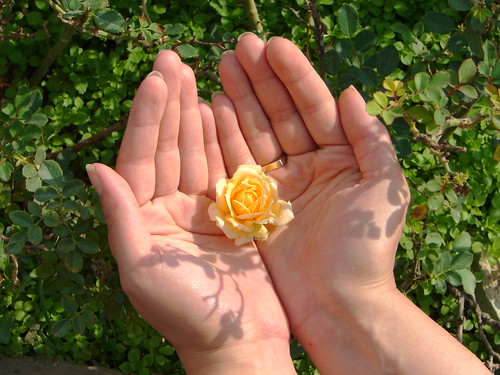
I find the word "gratitude" a pet peeve in real life, because parents have always used it in a context to "be grateful" in a tone that immediately makes one's hair prickle. "Gratitude" implies that we have to appreciate what we have, not that we have a choice in the matter. Complaints become the vermin of the household, the cockroaches that must be stamped out during stressful times. If it were up to me, I'd rather count my blessings on my own rather than have a parent remind me to count them. I have a planner for a reason, so I can write down my reasons to be grateful in there. 

Image source: http://farm4.staticflickr.com/3138/2939241447_62d268f936.jpg

Fiction offers a different take on the idea of being grateful. If not for luck, and perhaps a bit of help, most protagonists would not survive past the first page. Some authors even have fun playing with the idea, like Lemony Snicket in A Series of Unfortunate Events. Although the Baudelaire orphans in the books have their fair share of bad luck, from the fire that kills their parents to the different circumstances that lead each of their guardians to die or abandon them, they also have enough luck and time to foil Count Olaf's latest scheme to obtain them, or they'd have disappeared in The Bad Beginning. The siblings also stay together, and while their allies and enemies meet untimely, creative ends in each book, they somehow manage to resolve their conflict with Olaf and grow up into normal people.
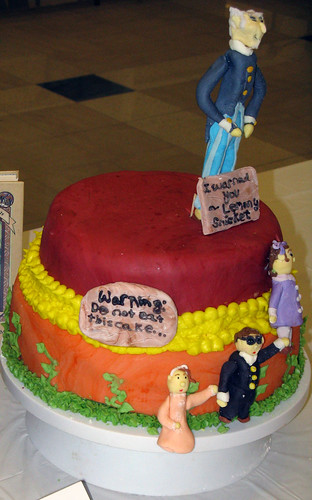

Image source: http://farm6.staticflickr.com/5209/5350696176_ca6de8a7c4.jpg

People also don't like complaining, self-degrading heroes. One has to look at the frustration with Harry Potter in Order of the Phoenix or the dislike for Bella Swan from Twilight to see this self-degradation in action. Heroes suffer, and protagonists have issues, but one peep of discontent and the readers pounce on it, even if the complaints are legitimate. Harry spends most of the book suffering PTSD, for example, and thus lashes out at the people around him for not understanding why fighting Voldemort traumatized him. The next book featured him overcoming the trauma, accepting his fate to take Voldemort and knowing that he will probably get killed.
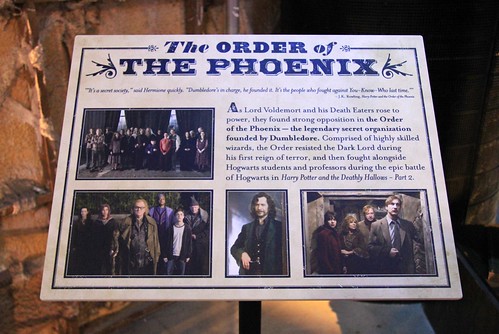

Image source: http://farm6.staticflickr.com/5155/7190188251_ca6a9d788c.jpg


Heroes need to feel grateful in fiction because they receive chances that they wouldn't receive in real life. Had Harry not received his Hogwarts letter, for example, as well as the dangerous adventures that Hogwarts provided, the Dursleys would have confined to an abusive, dreary existence in the Muggle world as a neglected orphan.  Rowling cannot help but poke fun at this situation; when Harry's Aunt Marge says she would have sent him to an orphanage if it were up to her, Harry thinks that he would have preferred an orphanage. Even so, he manages a polite goodbye in book seven, considering the circumstances, and stays in touch with his cousin after the series concludes. Living with the Dursleys saved his life, even if they didn't treat him like a surrogate son, and he lets go of his animosity towards the wizards and Muggles who have made him suffer. 


 Image source: http://farm6.staticflickr.com/5281/5203091533_8cd45563bd.jpg

So there are my ten minutes and more on gratitude, on my preference for heroes who acknowledge that their lives suck but deal with the villains and monsters, knowing no one else will.  Now I'm off to prepare for Thanksgiving, by getting my end of the semester work out of the way.


Tuesday, October 29, 2013

The Writing Zone


Hi all long time no see. There's loads of news, however, that I will reveal. First, on November 1 Indian SF is publishing my short story "The Lion in the Wave," on their website; be sure to check it out and to give the magazine your support if you can provide anything, from readership to funds. "Lion" is an ocean story, about my fear of large waves and how their crashes sound like lions' roars, and it's my first successful attempt at a literary style.

The reason I've been AWOL is because I've been working on a novella for an editor, a fantasy horror novella expanded from a short story that I finished in the fall. The time that I would have spent crafting a response to a StoryDam prompt instead went into reading about Tarot, studying the language behind Ray Bradbury's novel Something Wicked This Way Comes, listening to my new beta reader's comments on the story, and writing about twenty thousand words in a week and several days. The editor is reading the novella this week, so I have my fingers crossed.

"Carousel" is about a haunted orchestra conductor who fears a strange creature called the Piper, a humanized force of chaos that steals children with his magic flute. He suddenly makes reappearance at her university, first taking the sound away from orchestra rehearsal. She has to become someone she hasn't been in a while to confront the person who summoned the Piper, as well as to get rid of him.


Novellas typically start at twenty thousand words, which is roughly one hundred pages double-spaced, with Times New Roman font sized 12. I have written three thousand words a day, every other day. With that track record, I thought adding twelve thousand words to an eight thousand word short story would be a cinch. I'd set up my computer at night, or during two hours I had free in the morning, and type away. I even had a day off I knew the story's plot, what I wanted the characters to do. All I had to do was write, write write, which is what I enjoy doing! Surely nothing could be easier!

I couldn't have been more wrong. See, the times I had been writing three thousand words a day had involved some form of having three or four hours a day to write freely, or when I had been willing to stay up till midnight putting in the work. They were also part of fanfiction, which I have always found easier to write than original fiction-- that will be another blog post's subject. Original fiction requires the brain to produce more description, in terms of picturing the world and how the characters act. I had to borrow liberally from my university campus, and then memoirs of driving to Miami Beach at night for the new climax.


To immerse myself into the novella's world, to be able to expand, to explain, to make deeper characterizations, I had to swallow the necessary language, research, and suspension of disbelief. Something Wicked This Way Comes inspired part of the story, including the title, but only in terms of how a fun place or object has creepier implications, that you have to cling to joy and laughter to fight the darkness that threatens your soul. Bradbury's prose also emphasizes that not all parents fail their children in times of crisis, and that sometimes an adult can provide wisdom that the children lack. I consider it one of his more uplifting, nostalgic tales about the wandering carnivals that don't appear any more these days.

I also had to answer a lot of questions. My first beta reader had complained that draft four hadn't held enough back stories. Beta reader two didn't complain about that, but rather about how the protagonist let weeks of time go by before taking action, and that the climax did not satisfy him. A male love interest had no personality or motivation, and the Piper wasn't threatening enough. Both readers went on a long rant, which meant that they liked the story and were frustrated by its shortcomings.

The story had to change. I ended up throwing out the old ending, which had survived six drafts, and crafted a new one. That took four hours to write, on two separate days. Only then, sweaty and relieved, did I email the draft to the editor, who was gracious enough to accept my submission and who let me resubmit it with correct formatting.

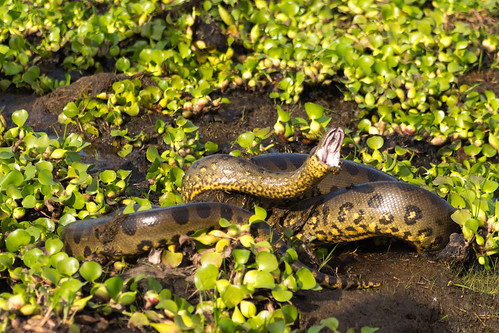
"Carousel" taught me many things: one, a story can always get longer. Sometimes it will stretch like an anaconda, demanding that you count every scale on its body till you reach the end, sweaty and exhausted. Sometimes you have to let that anaconda grow, and grow, so that you can get the best story possible.


Two, always answer a readers' questions. Though Stephen King likes to write short horror stories that have no explanation for the supernatural causes, we cannot all be Stephen King and the age to abruptly blame haunted laundry machines on nightshade and mandrake root has passed and gone rotten in the grave. When two readers want back story, even if you dislike flashbacks, provide back story. Connect characters that were previously drifting like bits of seaweed in an ocean current.


Three, write what you know, and what you only know. Not every writer has played in an orchestra like I have, and not every person noticed the clock tower that played melodies at noon on my university campus.


Next post will be about Halloween, and I promise it will be on time, maybe on Thursday. We'll see what I can write this week.

Friday, September 20, 2013

Beloved Books on Banning: Fahrenheit 451

Image source: http://farm1.staticflickr.com/228/517900257_2515938cd4_z.jpg

"There is more than one way to burn a book." - Ray Bradbury


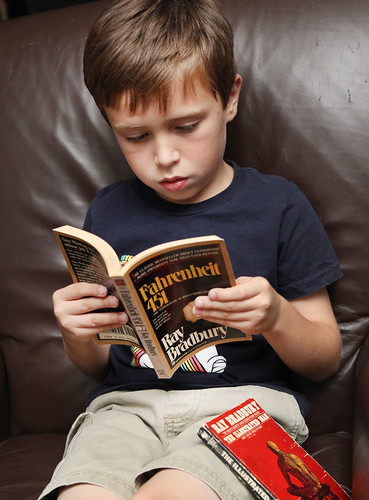
I was originally debating whether or not to review my experience in rereading the story behind Ray Bradbury's iconic work, or to discuss a tome with more modern concerns.  As it were, since I forgot that I had signed up for Friday, not Saturday, I am going to write my unorganized thoughts on the book, as well as my experience in rereading it as an adult.


Image source: http://farm6.staticflickr.com/5061/5647935372_1d42d56d96_z.jpg

"It was a pleasure to burn."

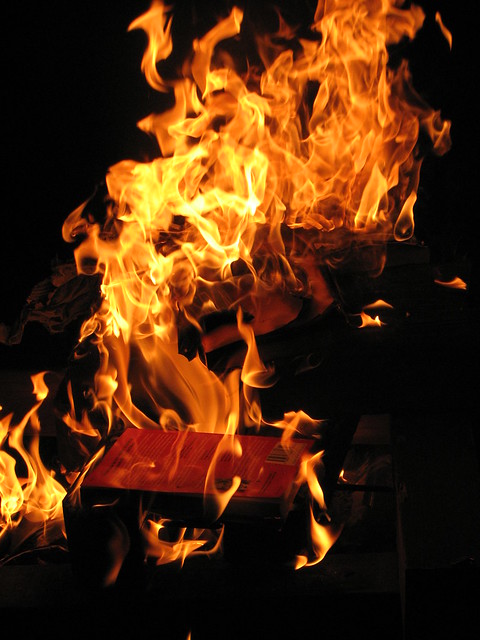
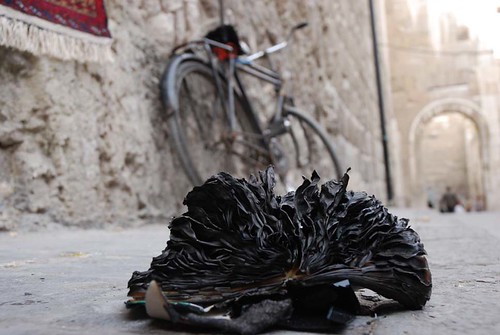
Fahrenheit 451 was THE book on how pervasive censorship could become, while finding new employment for firemen in the future. With houses that wouldn't burn down, even in the event of wildfires, what are you going to do with those athletic public service agent? Pay them to enforce the law. Make sure the kids aren't thinking for themselves. 

This Bradbury yarn enthralled me as a kid, not the least because it featured a world where the written word was forbidden. Fahrenheit 451 also features a grown adult stuck in a loveless marriage, changing for the better because he meets a young girl. Clarisse has ideas about responsibility, living in the moment, and trying a new thing once or even twice. The young, idealistic me immediately sided with Clarisse and her whimsical games, opening her mouth to catch raindrops and rubbing flowers under her chin. And like Montag, her disappearance surprised and shocked me out of the established world this novel had set.

The power of words also stayed with me. When Montag saves a book from an old woman's scorched library, he reads out the poem "Dover Beach" to his wife's friends on a whim. They're just as shallow as she is, and yet the words touch them. Having never had such an experience with poetry, the idea was foreign until I read some of Bradbury's verses and recited them for a middle school contest. The fact that words have so much power when assembled together made their mark on me, and I can only strive to do the same with my own craftsmanship.

Image source: http://farm8.staticflickr.com/7095/7161393937_889248ab23.jpg

As an adult, the power that oppression gives to a law enforcer also has a delicious thrill that the hero Guy Montag feels. The first line admits to that pleasure, to seeing organized destruction in the air. The human race bans books for a reason, after all; books provide the gateway to learning more about the world, about its harsh realities and potential for strong communication. We see how a man like Commander Beatty revels in his job as head fireman, why he laughs about the history of how books entered the incinerator.

Is the book still relevant, regarding books, censorship and book burning? Heck yes! We live in a world where Pakistan tried to execute a girl for burning the Koran, where school libraries fire employees for bringing book challenges to the press, and where several states in the United States want to erase evolution from the science curriculum. Humans desire to destroy access to powerful words, to crush others seeking to rise with knowledge and opportunity. Selfish individuals and fearful souls wish for happiness and will sacrifice the questioning mind to do so. That is a fact, that we intellectuals have this ongoing battle with censors, with the books that offend us -- A Song of Ice and Fire for me-- and with ourselves, understanding why reading is a liberty that we should allow for our fellow men.

Image source: http://farm3.staticflickr.com/2370/2081984776_5b3ded020b.jpg

There is only one thing we can do to persist in this battle: draw attention to the fire departments. Use the words they seek to burn to rebuild new pages and minds.


Note: first person to comment here receives one of my original comics, seen here, as well a a free watercolor of their choice. That is the giveaway for Banned Books Week!