Wednesday, June 11, 2014

Bloggers Pseudonymous: Iron Galleon Beach

 Hi, everyone! Hope you had a good weekend. Below is a little deviation from the norm, a multi-blog serial called "Iron Galleon Beach." Matt Anderson, Corissa Glasheen, Philip McCall I, Rebecca Curtis and Kathryn Phillips are going to . As Matt has described this project to the five of us:
"This is a group of talented, young writers - and bloggers - and the goal is simple. Together, we will write a story, with each participating individual writing one chapter of approx. 3,000 words.
 I agreed to write the first part of the story, and then another blogger will take up the challenge. Without further ado, let me introduce "Iron Galleon Beach."
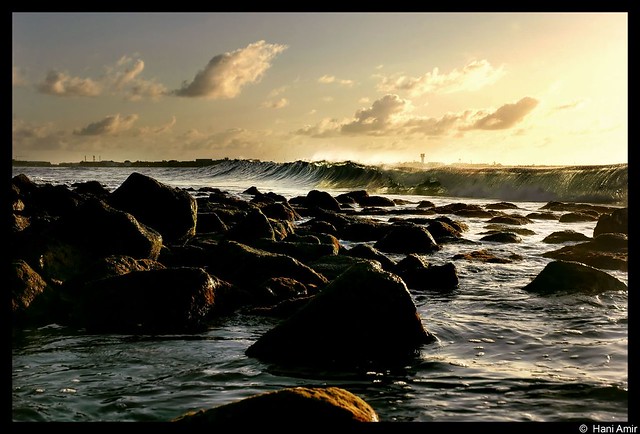
Image source: https://farm2.staticflickr.com/1151/923137607_1396729009_z_d.jpg?zz=1

Iron Galleon Beach, Part One

Summer vacation should not involve mermen. At least, that was Raffi's opinion as he stared at the secluded sandbar in front of them, fangs seething under their protective gums. Nor should it involve bleeding mermen and men with sharp weapons standing over them.
When he and his friends had chosen to visit Iron Galleon Beach for Memorial Day, several things had stood out to Raffi: they did not need visas to arrive to the island, a good thing since Raffi as a vampire could not appear on film. Their beach house had cheap rent despite having three rooms and two bathrooms; and there was no civil wars or coup d'etats going on nearby.  Most importantly, they needed the seclusion in case one of them had an episode, like if Nadia needed to do her werebear transformation, or if Fiona had to whip up some plant magic. The butcher in town didn't ask questions about the large steaks that Raffi had to buy for his health, or that his eyes flickered when facing the blood. It was the perfect vacation spot for four motley monsters.
They had not expected to find poachers here any more than they had expected to find merfolk. That was because Iron Galleon Beach relied on tourism with white people, and thus needed a good public image. A nearby island, Barbados, had received flak for letting the Pirates of the Caribbean people kill dozens of sea turtles while filming. Iron Galleon Beach couldn't afford similar bad press. If Nadia hadn't suggested a morning stroll to explore the island then the four might never have encountered this hidden beach, or the poacher. That was because the beach was hidden by thick mangroves and sawgrass, so that only a keen-eyed girl like Nadia would spot the path. It didn’t have a nice view either, like the other, more popular beaches on the island.
It made Raffi want to swoop down and smack that man silly with his guitar, then chomp down on his neck. Only he had left his guitar at their house. Turning to look at the three people next to him he saw that his friend Nadia wanted to do the same. The hair on her arms had already started to thicken. Alex was turning a shade of dark grey that indicated cold, icy fury. Fiona’s eyes had gone dark green, the color of cool jade.
The man in question had tanned skin, an ugly orange and pink swimsuit that tightened around his crotch too much, and a tight tank top with the same horrid colors. He wore cheap blue sunglasses, but his weapons spoke of expense; he had the merman trapped in a barbed metal net, with a hook wedged into its neck. A large brown satchel was strapped to his back, rattling with other weapons. The merman was struggling to breathe on the beach sand, not able to speak due to its gills not having water. Judging by the coloring and clothes - sheets of red and green kelp knotted around its waist - Raffi had deemed it female. At least until Alex spoke up.
"He's dying," Alex said. "No creature can survive with that amount of blood loss."
Raffi grimaced. It wasn't that he minded the sight of blood; he was a vampire, and on a normal day, he'd be guzzling a pint down with each raw meal to satiate his hunger. He minded the fact that someone was inflicting pain on a magical person like himself and his four friends, and that the person seemed to be enjoying running a large hook through a helpless merman.
The man looked up from his handiwork. He noticed four college graduates staring at him, one that was translucent white, another with dark sunglasses and covered in clothing from head to toe, a girl with plant tattoos swirling over her arms and legs, and another girl slowly growing fur and fangs. He didn't seem phased.
"Seems I have company," he said in a clear American accent. Not a native then, and not one of the locals who catered to the tourists.
"Let the fish go," Alex said, swooping forward. Raffi reached out an arm to stop him, but then realized that Alex was probably the best person to charge. Nothing could harm a ghost, after all, that could harm a living being. Unfortunately, ghosts were not able to harm living beings either, except to possess them and compel them to do strange behavior.
This poacher seemed to know that last bit of knowledge about ghosts because he dropped the net and the hook and sidestepped Alex. Then he whipped a small jar out from his satchel, opened the lid, and held it out. Within a few minutes, all of Alex’s essence ended up inside the jar, trapped. The poacher closed the lid and tucked the jar into his satchel.
Nadia gave a frustrated grunt. Fiona the nymph slapped a delicate palm to her forehead. It sounded like a wooden stick hitting a beech tree. Then she and Nadia moved to get between the poacher and the trapped merman, cutting him off. Her bare feet touched the water and made small ripples.
Raffi ignored Alex's gaffe, leveled eyes with the hunter, revealing his fangs. The sunglasses made him look intimidating, but he wished he were wearing a trench coat instead of a bright green Seminole shirt. Trench coats were too hot for the summer, however, and Raffi try as he might would never appear as an intimidating Edward Cullen or Angel. He also lacked their physical strength and combat skills. Contrary to public myth, vampires did not always possess the power to punch a demon in the face or even crush a human skill. They sometimes had to bluff.
"We don't want to hurt you." Raffi gave a wide grin, showing his fangs. "But it seems you know too much about us. And about . . . them."
He indicated the flopping merman and Alex’s protests from the satchel. The man didn't seem surprised that Raffi was a vampire. He eyed Nadia and Fiona with more appreciate astonishment.
"A vampire. And an idiot ghost. With lady friends."
"Hey!" Alex called from the jar, voice still muffled. "I'm a National Merit Scholar!"
"Alex, let us handle this," Raffi said. He cleared his throat, fangs extended to their full length. "But the 'idiot ghost' is right; let the merman and him go, or we'll tear you to pieces."
"You and what army?" The poacher asked. "It's not like you can call the police."
There was a beat of silence, as the four of them registered this insolence. The poacher's response showed a remarkable level of intelligence for someone who didn't realize he was in trouble.
"You have a point," Raffi admitted. "Given the police are more likely to send us in for dissection and permanent confinement than getting you in the clinker. But that means we're outside the law, which means we can do anything we like to you. And we’re all an army."
"Unless your girlfriends can do more than toss cellphones, then you're really screwed," the poacher snarked. He reached for the satchel strapped to his back; Raffi braced himself.
He almost didn't see the wooden stake coming, the poacher seemed to keep small ones strapped to his Speedo. Raffi dodged the stake but more weapons kept coming. The poacher took the opportunity to land on top of him, straddled his fallen form, and hold a stake to his heart. The wooden tip pricked Raffi’s green shirt.
“Make one move, and I turn your boyfriend into ash,” he told the girls.
The girls had managed to get the hook out of the merman’s neck and had lowered him into the water so that he could breathe. Fiona was busy trying to implement the first aid she had learned in preparation for medical school. Nadia had her hands curled, however. From where he was pinned on the sand, Raffi could see her claws erupting.
“Get your legs off me,” Raffi grunted. “I’m not your type.”
"Everyone's my type," the poacher responded, leaning on him. "And you'll be the type for my latest bidders. They were hoping for seafood, but a live vampire is rare these days. Most of you sunspots burn up the minute wood touches your heart-"
He stopped as the stake pushed away from Raffi's chest. The stake started to wriggle like a serpent and sprout leaves. Then it turned on the poacher, to had to toss it aside.
Fiona's tattoos were writhing like the vines sprouting from the stakes, which had now turned on the poacher; her eyes had turned dark green. Green meant danger, for a nymph's wrath was worse than any fatal stab wound or hook to the neck. The poacher seemed to recognize this bit as well because he tried to back away.
"Let's see here, ladies," he said, reaching into his bag for some other repulsive weapon, "we can surely settle this dispute-"
Raffi took the opportunity to punch the poacher in the groin. It wasn't that much different from punching a piece of rotten fruit, and it had a similar, satisfying squish. The poacher hadn't thought to wear a cup and he yelped as Raffi pushed him off and managed another punch to the larger man's chest. Both scrambled away, and surveyed each other.
Fiona returned her attention to the merman when it gasped and flapped; Nadia then made her move. Her claws were like tiny daggers as she pounced on the poacher and managed to tear off part of his tank top. She had abandoned speech in favor of growling. If the guy hadn't used a satchel to block her, he would've had his chest torn out. He managed to flip away and reach into his duffel, but not before she had morphed into a small brown bear, large enough to tackle him to the ground.
"A foursome?" he cried in surprise and admiration, pulling out a large rifle. "I happened to stumble upon FOUR magical beings now? Is this my lucky or unlucky day?"
"Unlucky," Raffi and Fiona responded. Alex managed to answer as his transparent legs wriggled in the sand. Raffi had balled his hands into fists, but he was unable to charge in and throw a punch while Nadia-bear was trying to tear the guy apart. She was having trouble; If Nadia didn't get a good strike in, the poacher would be lodging a bullet through one of her furry arms.
"Fiona, I need ammo," Raffi said. He dug into his pockets and came out with a tiny bottle of sunscreen, the keys to their beach house, and his wallet. He had learned from a self-defense seminar that women could use keys to defend themselves from violent men, but he wasn't sure if they would be useful when attacking a violent poacher that apparently armed himself with stakes and guns. Sunscreen also wouldn't be useful because it was the stick variant, that you rubbed all over yourself; he should’ve sprung for the spray version, which burned the eyes.
Fortunately, the nymph listened while working their limited knowledge of first aid to try and save the beached mermaid. Small blooms of kelp had sprouted in the shallow water and Fiona used them to clot the blood spurting from the unfortunate fish-boy's neck. She spoke to him calmly, but he was thrashing and not used to this treatment from any human. As she talked and reverted to the language of plants, the vines and roots crept from the nearby dunes. The poacher and Nadia-bear didn't notice while attempting to grapple with each other. Raffi took care to not touch any of the vines, though he saw seed pods on one and slashed his house key against it. Large yellow spores shot at the man, hitting his legs. The poacher swore, giving Nadia an opportunity to push him down. The problem was that she didn't take it because he was still holding that stupid rifle. She merely swiped at him, hesitating for that primal fear.
Raffi decided to step in. He took a chance and grabbed a fistful of the seeds. It made the skin on his palm itch, but he didn't care. Nadia was doing a great deal, but she wasn't doing enough to stop this guy. A vampire sometimes had to pull his weight when fighting a common enemy.
The spores made a better, bigger impact when they hit the poacher's arms. It messed up his concentration and made him drop the rifle. Nadia-bear took the opportunity to kick away the rifle, making sure its firing end got buried deeply in the sand, and to scratch at his pack. Several items fell out, including the jar containing Alex.
"Nadia!" Raffi called. "Forget the firearms. He's trying to escape!"
Indeed, the poacher had realized that despite all possible weapons that he was perhaps out of his league and he was making a quiet getaway. Raffi remembered the time he had accompanied Nadia to that self-defense seminar, the one with the key slashing, and made to body-slam the guy, breaking the poacher's sense of gravity. That was the theory, at least; part of it worked when Raffi managed to knock the guy off-balance and grab his shirt to punch him some more. The problem was that the poacher was apparently used to having vampires body slam him because he stood tall and firm, like a wicked yew tree. Raffi bounced off him, feeling the tank top tear in his arms. His sunglasses cracked.
“It seems you have friends in high places,” the man said as he reached for small grey balls, including Nadia-bear who was rearing for another charge. “You win for now, but I’m not leaving this island empty-handed, and certainly not with an idiot ghost.”
Nadia-bear yelped when the poacher released the balls; they produced tiny explosions and blinding light. Raffi shielded his eyes. Alex couldn’t feel the explosions due to being a ghost and trapped in a jar, but the sand vibrated from the impact. Fiona wasn’t paying attention because she was attempting to apply CPR to the unfortunate merman. By the time everyone recovered, the poacher had vanished.
"You know," Raffi said to the sky, "we didn’t come here to fight. We came to relax."
His left hand was still clutching the poacher's shirt. It smelled like rotten fish, salt, and ash. Nadia-bear couldn’t change herself back into a human for a couple of hours, but she could regain her human thoughts. She crouched down and bit on a stake. Within a few minutes, Raffi was free. He sat up, stroked the scratch on his black lenses, and moved to help Fiona. So did the others.
“What did I miss?” Alex asked as he struggled out of jar and onto the sand. When they all gave him a funny look, even Nadia with her large black bear eyes, he said, “How was I supposed to know that the dude knew about ghosts? Most of them freak out when they see me going white!”
“You need to work on your scare tactics,” Raffi said grimly, rubbing his arms where the stakes had pinned him to the sand. “Now I think that dude wants us all in a cage, since we cost him his fish boy.”
"Don't speak ill of the dying," Fiona said sharply; she never snapped, so they all turned to look at her. Nadia-bear shuffled over and sniffed the bleeding merman; it shied away and started to panic. Fiona ordered Nadia-bear to stand at a distance, so as not to panic her patient.
They forgot about the poacher and the fact that he had gotten away; what mattered was saving one of their brethren. Fiona did what she could to staunch the blood, but it kept coming. The poacher’s hook seemed to have severed an artery, so that no bandages could stop the unwanted gush of red. Fiona’s hands and clothes became coated in blood but she kept trying to save him.
Raffi knew nothing about first aid, The others all did what they could to help. Nadia-bear was purring to the merman while supporting his head. Bears could purr like cats, and Raffi had learned that the sound was calming to most animals. This didn't seem to help the merman though, because he was still thrashing about. Perhaps he thought Nadia-bear wanted to eat him. Alex started to hum a low chant, probably one meant for easing pain. That seemed to go better, though the chant made everyone quiet and sober.
Raffi stared at where the poacher had vanished. His hands were still aching from where they had clutched Fiona’s seed pods and he was still clutching the poacher’s torn shirt.
"He got away," he said. "That jerk got away. He knows we have a vampire in the group and other unusual creatures."
Oddly enough, Raffi wasn’t that worried about being put on the market and sold as a living vampire. That fear was an abstraction, a cautionary tale used after Twilight had made vampires a popular commodity for wealthy women. He was more worried about his friends, and about being outed, since that had happened before.
The dude knows we’re on the island. It’s a small town, and he might find out where we live. He could plan to catch us off guard, so as not to leave “empty-handed”.
Raffi used a much worse word than "jerk," when the merman lay still and stopped breathing, head lying in the water. The smell of blood and salt made him feel queasy, even for vampire standards.
Fiona took a moment, still tightening the knots on the makeshift bandage for the merman. Nadia-bear growled, sniffing the air. Then she shuffled over and sniffed the torn cloth in Raffi’s hands. Before he could stop her, the were-bear gave a great snort and started trundling off, running off into the mangroves. Raffi groaned and Alex soared after Nadia-bear.
Why did our summer vacation have to involve mermen?

Friday, June 6, 2014

Liebster Award Answers

Hi everyone! Good to see all of you. Matt Anderson nominated me for a Liebster award, after he got nominated for one. To get the award, I am going to answer eleven questions that he has posed, provide eleven random facts about myself, and then nominate five bloggers who each have less than two hundred followers, asking them eleven questions.

1. Who are You? [the Who]

I am Priya Sridhar, an American with Asian heritage from the country of India. I am completely Americanized however and do not speak a word of Hindi or Tamil; my languages are English and Spanish, with a smattering of Japanese.

2. Are you Happy Now? [Michelle Branch]

I'm always happy when I write, unless I'm venting. At the moment I'm not venting so I'm pretty happy, especially since I got an acceptance in a week of rejections.

3.Who Do You Want to Be? [Oingo Boingo]

I want to be J.K. Rowling, William Joyce or Scott Westerfeld. But since I can't be any of them, I'd rather be myself at the moment. 

4. Will You Be Ready? [Imogen Heap ft. Murdock]

No. I will never be ready. But I will prepare to the best of my ability for whatever comes.

5. Where's Your Head At? [Basement Jaxx]

Somewhere in the book that I was reading, a Maya Angelou biography. 

6. What is Love? [Haddaway

Not answering this one because the song annoys me to death. 

7. Turn Down For What? [DJ Snake & Lil Jon]

I've mainly been turned down for internships and jobs. Still, eventually the rejections stop coming.

8. What's your Flava? [Craig David]

No comment, except that my favorite flavor of dessert is chocolate.

9. Do you Believe in Magic? [The Lovin' Spoonful]

No, except in the magic of words and in artwork. The supernatural is beyond me. 

10. (is there) Life on Mars? [David Bowie]

There was, billions of years ago.  Now, probably not.

11. Any Advice? [Nonpoint]

Just this: no matter what anyone tells you, don't be afraid to make mistakes. Just remember to learn from them, without losing your head.  

So the eleven facts . .  .

1. I used to have an intense phobia of snakes and drowning, and no the two were not related to each other.

2. I am an obsessed HTTYD fan. When I was a kid and teenager, the obsession was Harry Potter. Harry Potter still rocks.

3. On principle I will not watch the movie Maleficent, good as it may be. For more information, see my Tumblr post about my reasons.

4. I do not like iguanas. At all.

5. My story "The Fish With Legs" came out today. Hope you get the chance to read it and comment.

6. I am a member of Toastmasters, a public speaking seminar.

7. Favorite holiday is Halloween

8. Favorite webcomic at the moment is Love and Capes, closely followed by Albert and Serenity.

9. I love chocolate.

10. I also love cute animal videos; they're my weakness, especially ducklings.

11. I do not know how to use an Ames guide for lettering comics.

Now, for the five bloggers I will nominated several of my writer and editor friends: Corissa Glasheen, Morgan Dragonwillow, Philip Tolhurst, Terrie Leigh Relf, and Kathryn Phillips. Here are my questions for you four lovelies:

1. Why do you write?

2. What do you fear the most when reading a new book?

3. Dragons, vampires, or mermaids?

4. What do you love the most when reading a new book?

5. Do you listen to background music while writing?

6. Stephen King believes writing about scary things means they'll never happen in real life. Diana Wynne Jones had events from her books happening to her after she wrote them. Do you think writing about an event stops or causes it from happening?

7. Favorite genre?

8. Least-favorite genre?

9. Ideal vacation?

10. How powerful can books be, in the right or wrong hands?

11.  What book will you read over and over again?

Happy answering! Hope you all enjoy these tidbits, answers and questions


Friday, May 30, 2014

Writing for Other People

"On This Site in 1987, Nothing Happened". Vacation photo from the Casablanca restaurant in Los Angeles.
Hi everyone. I was away on vacation for the past week, visiting California with family. Later I may write a blog post about it, but first I want to talk about a topic that has recently become important in my life: writing for other people. By that I mean writing a story for another person on request, the plot to their specifications. It's very much like commissioning a work of art in words, and you can even do them for birthdays or for Secret Santas during Christmas. Other times you can do them for an anthology, or when ghost-writing for a well-known author. This post will cover these various options.

First, writing for your friends and family. I find this a personal pleasure because people usually give me ideas and a lot of flexibility. My writing has recently improved over the past year as well, so I usually don't skimp on plot or implausible resolutions. The friends who read the tales appreciate that someone took the time to pay attention to their ideas, to expand on them and create a small world in which unique ideas and requests exist.

Let me turn to two varying examples. On May 4, my story "The Soothsayer" was published in Sorcerous Signals magazine. I hope that anyone who can donate to the magazine will, because it was an honor to have editor Carol Hightshoe choose my work. "The Soothsayer" was written for my friend and fellow author Corissa Glasheen, who was suffering a rough week and a sick day. She asked for a story about a psychic whose power involves dead people, and that it was all. I wrote a tale that fit the bill, albeit one that also involved the Sleeping Beauty story and talked about kings and queens. Carol Hightshoe liked it as much as Cory did.

For her birthday last year, Cory asked for a story about cosplaying, or dressing up as your favorite fictional character. I wrote a complicated tale about a cosplayer designing a Big Ben costume, Big Ben being the clock in London. Half the people who have read the tale, including Cory, love it; the other half dislike it because they have no idea what's going on. One day I'll figure out how to revise the story so that it doesn't confuse the other half, but it fills my heart with pleasure to know that Cory enjoyed the tale.

Cory is one of the most poetic young writers hitting the South Florida atmosphere, so you should totally read her blog and story in the upcoming Flux-Fiction Anthology
Image source: http://thelittleprotege.com/wp-content/uploads/2013/07/DSCF2220-copy-copy.jpg

Matt Anderson and I have had some soul-searching discussions on the topic, for reasons that I'll mention below. He and I agree that we should write to please ourselves first, and to write for friends if you can and they like your writing but he and I differ on what it means to write for other people that will pay you for your work. Here I am referring to anthologies, or  "a published collection of writings (such as poems or short stories) by different authors" according to Merriam-Webster online.

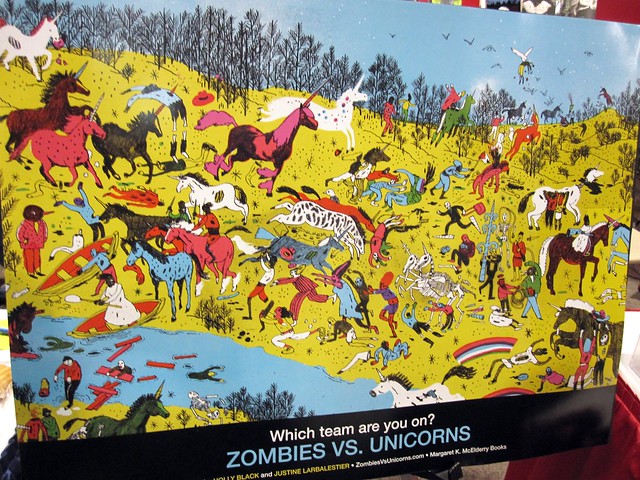
Anthologies often center around a given theme, from shape-shifting to supernatural prom nights to bad kisses, and rely on unique author voices to tell different tales. Most fantasy and science fiction authors have contributed to or created various anthologies: Bruce Coville of Unicorn Chronicles fame has assembled about half a dozen, as has Jane Yolen, Terri Windling and Ellen Datlow. Neil Gaiman recalls how an anthology prompt saved him from a weekend of writer's block in his short story collection Smoke and Mirrors, and Justine Larbalestier blogged with glee about the fictional battles between zombies and unicorns in their titular anthology.

Not making this up; this anthology exists. I'm Team Unicorn.
Image source: https://farm5.staticflickr.com/4107/4841309602_bd3c077758_z_d.jpg

Cory was kind enough to introduce me to a local fantasy author Philip McCall II in the fall. After reading the first chapter of my wolf novel, Phil asked me and Cory if we could contribute to his latest anthology, Flux-Fiction Volume I. He made the same request to Matt after reading one of the latter's short stories, liking the writing. He gave us each a prompt, a character from his God Gates universe, plot outlines and a reasonable deadline. After the emails with such information, Phil then made himself available on Facebook so that we could ask questions and even provided visual references for some of the characters.

It was quite a new experience, receiving permission to write about another author's characters and to not have to slap the fan fiction label onto my story. Having an established continuity and characters, much like when writing fan fiction, helped ease the writing process because I only had to make up the details. Knowing that the author had given us each a tremendous opportunity increased pressure, however, since we were putting various spins on his beloved characters.

 Phil kept encouraging me however; he had chosen us to write because he believed in our prose. He knew that we could come up with powerful narratives, nerves aside, and that we would turn in our stories before the May deadline. As a writer himself, Phil also knows that encouragement keeps inspiration and creative determination alive; when I sent him my story's first thousand words, for example, he sent back a raving response and mentioned the excerpt on Facebook. Knowing that he enjoyed the prose so much gave me the confidence to finish, and to write an action-packed, bloody tragedy. It was a great joy to know that such words could come from my fingertips, and that the story pleased more than one person. Matt and Cory's tales are also amazing, and I have read enough of V.B. Kennedy's prose to know that her story will be a hit.

I like writing for other people because I can make them happy, and because the most delicious words arise from such a creative challenge. Knowing that I can rise to the challenge makes me excited for more writing prompts, like from Eggplant Literary Publishing for their children's magazine Spellbound. It also makes me excited to write a new tale for Cory this year for her birthday, to see what ideas will emerge from her requests.


Sunday, May 11, 2014

Mother's Day: Mothers and Creativity

This past week, I graduated from college. For the first time I have a degree in hand, and a future ahead of me. What that future will bring, I do not know. But that will be for another post.

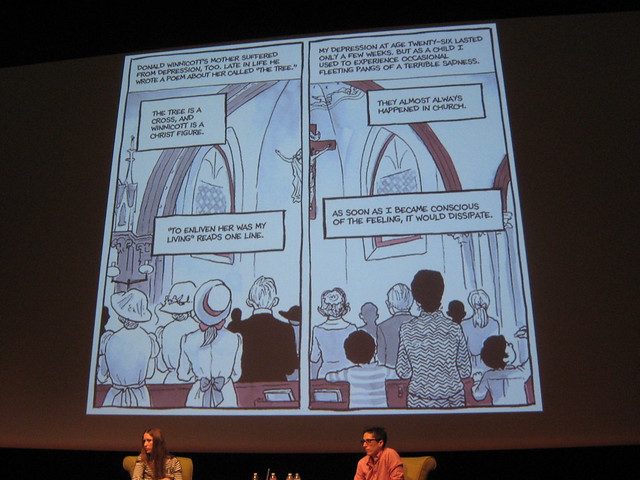
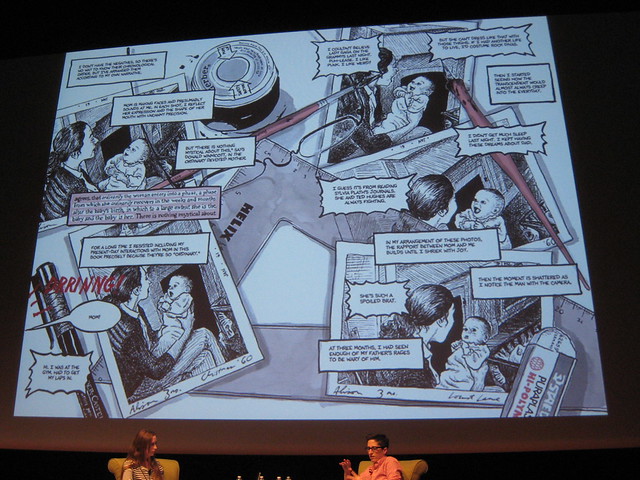
I am an Alison Bechdel fan. For those who don't know, Alison Bechdel is a lesbian cartoonist who has written two graphic memoirs: Fun Home and Are You My Mother? These memoirs concern how her parents influenced the choices that she would later make, namely the choice to not settle down and conform to society as well as to become an artist.

Image source: https://farm8.staticflickr.com/7240/7244742830_c5beff22a4_z_d.jpg

Are You My Mother? was a surprise this year, and a difficult read because it focuses on psychoanalysis and child psychology. I will probably reread it with a psychology textbook in hand to understand the interpretations completely, but one common element emerged from the narrative: the mother-daughter relationship, with art influencing its direction. I found myself relating to Bechdel's narrative, because I am an artist as well, and I have a similar relationship with my mother. Granted, I am not a prominent cartoonist and I still live at home, but my mom has had a strong influence on me.

My mom is a doctor, a teacher, and a role model. She raised five kids on her own after my father died in 2001, pushing us all to excel and to love one another. She allowed me to buy my first watercolor set and brushes in the eighth grade, which still serves as my main set for today. Even though she doesn't understand most of my comics, or any high fantasy fiction, she allows me to write and draw these tales by supporting me. She has encouraged me to take a more sensible path but hasn't pushed me to enter law or medical school. For that, I commend and thank her. Thank you, Mom.

Image source: https://farm8.staticflickr.com/7076/7244742204_1ee3670c96_z_d.jpg
Like my mom, Alison Bechdel's mother had to keep a crazy household together. She put her academic career on hold to raise three children and acted in various plays, satisfying her talents and need to perform. She does not approve of her daughter's comics, though more out of disapproval than confusion; she says as much in the first twenty pages of  Are You My Mother? Yet she provided financial support for the younger Bechdel as well as the information needed for writing the memoirs, like photographs and love letters. Without such information, Fun Home would not have the contrasting, handwritten fonts or detailed recreations of decades-old pictures. True love is allowing someone to explore their passion, to explore the deep caves that you would not explore, and Bechdel's mother has certainly conveyed that love.

Once again, thank you, Mom, for letting me grow into a writer. Thank you for pushing me to work hard in school and develop homework ethics. Thank you for reading a fantasy short story that I wrote in high school and offering points of critique, so that it won second place in a local competition. Thank you for the watercolor set that I keep close by on my desk, and thank you for the time that I have to paint.

Saturday, April 26, 2014

Last Post on Fanfiction: OCs That Add to Narrative

Happy belated Easter, everyone! I'm so sorry for not updating recently. The past few months haven't been that busy, although Alban Lake accepted one of my short stories for publication, and my real reason for not posting is that I didn't have decent topics, what with writing fiction for anthologies and such.

A while  back, Matt Anderson wrote a blog entry on Revamping established works through photo manipulations, fanfiction, and television show gags. Essentially, these works served as a springboard for new ideas and interpretations, whether they involve the Super Sentai becoming an American phenomenon as the Power Rangers or Harry Potter having rationalist foster parents. New stories emerged, new possibilities. Matt is even writing a wonderful serial called Duke Forever, in which a black Time Lord explores various worlds with an elevator-shaped time-ship and Stargates.

There comes one question, however: if you change so much about the established work, then why not make it your own story, with an original setting and all?

My argument is that the fine line relies on the established world. Buffy the Vampire Slayer, for example, changed the world of slasher film genres and vampire lore by mandating a chosen girl to stake vampires and protect humans from evil creatures, rather than mandating that monsters and serials go for the cheerleaders first. Joss Whedon changed the role for pretty girls in the horror genre, giving them a reason to fight monsters rather than to run. He rewrote the role to the point that when Buffy meets Dracula, the original famous vampire, she squeals over meeting him rather than running for her life, and learns about her Slayer legacy from him.
Image source: https://farm4.staticflickr.com/3548/3442653657_5bae19d6fc_b_d.jpg

With other established worlds, however, we find it much harder to build new settings for different characters. We liked Harry Potter not just because of the title character, but also because of the fascinating Wizarding World behind the Leaky Cauldron; they even built a theme park around the concept of visiting Diagon Alley and Hogwarts. We want to participate in that world despite the abuse of Memory Charms, prejudice against house elves and Muggleborn wizards, and Dolores Umbridge. We want to buy wands that choose the wizard, and to deliver notes via owl post. It's not a perfect world or a perfect story, but it's close enough and vibrant to the reader.

Image source: https://farm5.staticflickr.com/4113/5039294976_32b03a5cfb_z_d.jpg

World-building is hard work for a writer, especially for one inspired by a complicated world. If we derive too much from the established work, then we run into the risk of plagiarism. One author, Dmitri Yemets, found that out the hard way when he wrote a book called Tanya Grotter and the Magic Double Bass, which he claimed was a parody of Harry Potter. He faced a legal dispute from J.K. Rowling on releasing the book in the United Kingdom and the Netherlands, though he managed to keep publishing in Russian, and later on in Dutch. Yemets maintains that Tanya Grotter was a parody, and even wrote a book depicting the legal battle in this different fantasy world, taking a cheap shot to vent his anger.

I've recently encountered this interesting situation while writing original fiction based on How to Train Your Dragon. These stories don't feature dragons or Vikings, but they feature a nugget from the original book series that stuck with me. In one case, I changed the setting completely and wrote the story like a Criminal Minds episode, so that it's completely different from the original source. It blossomed into an emotional narrative and took a life of its own, all while I was writing dramatic fanfiction at the same time.  

The world has the last word, because setting defines the story as much as characters and plot do. If you want to write about scientists encountering magic wands in Harry Potter and avoid the lawsuits from J.K. Rowling, then transplant your characters in a new setting, finding that springboard of inspiration. Turn a genre cliche on its head, and allow the cheerleader to stake her vampires.

Good luck, fellow writers. A little bit of inspiration is full of surprises. 

Tuesday, February 25, 2014

Chains of Parenthood: Taking Care With Daughters and Parents


wsga

(This is for a school assignment involving blogging).


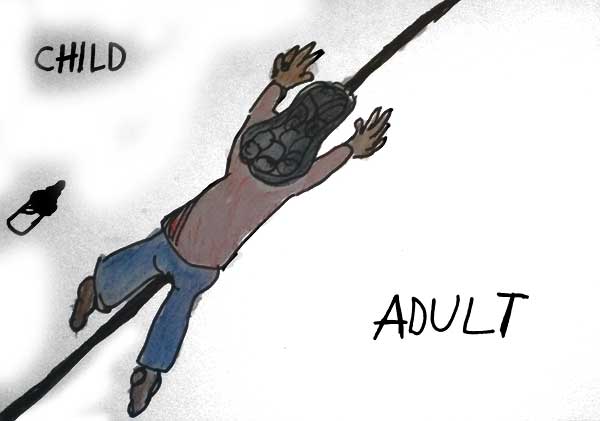
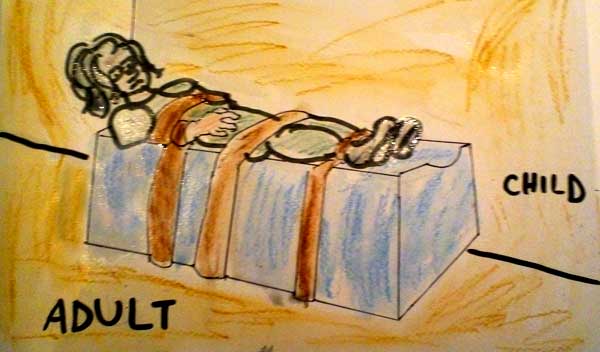
There is a frail line between adulthood and childhood. Legally, at 22, I am an independent young adult. I can drink as much as I like, pay taxes once I earn a certain income, or even get married.

Yet I, a sane if nervous undergraduate, live at home, under my mother's watchful eye. I have never had to pay a bill or hold a full-time job; in fact, the opposite has been encouraged, with me continuing my graduate education. That said, I have the choice to leave but not the conscience, on account of having a special needs younger brother who needs lots of love and care. Two of my siblings have left the house quite permanently and return to assist on holidays.

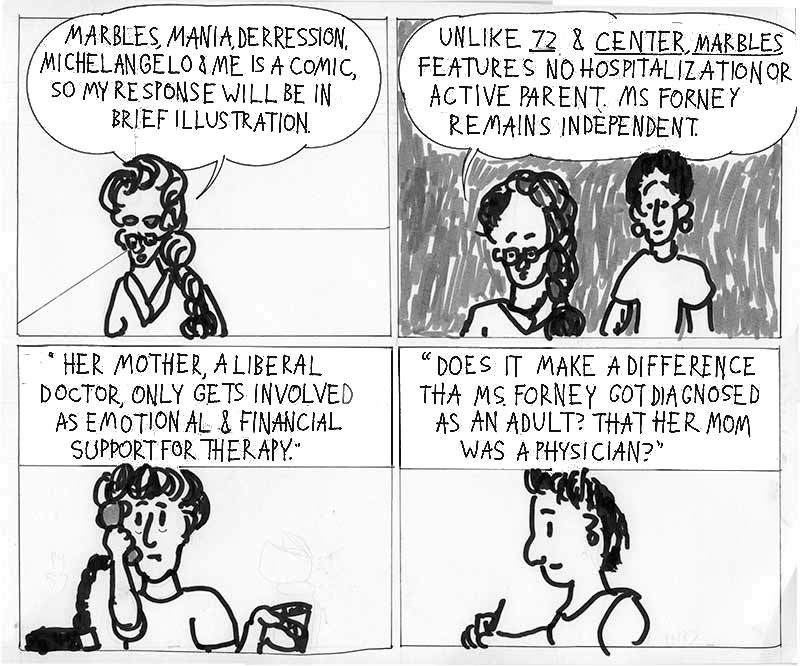
This project will compare real laws for conservatorship and mental incompetence, comparing them to situations portrayed in the books that we have read for Mental Illness in Literature: 72 Hour Hold, The Center Cannot Hold, and Marbles, Mania, Depression, Michelangelo & Me.I wish to express my views and emotions through visual images, deciding if parents provide and receive ample support when their adult daughters are ill.


Keri's California Catastrophewsgb

During my research into mental health laws, I have not found ample material to describe "parents" in regards to mentally ill sons and daughters who have reached the happy age of 18 and adulthood. Instead, the definition of "conservatorship" is used to define incompetent individuals who require a "conservator" to manage the individual's affairs; as the Special Needs Law Group writes online, "any adult can file for conservatorship".  Although conservatorship intends to protect the mentally ill or those with disabilities, the definition implies that a person with the ability to win over a judge will own another's finances, or deem a sane person unable to care for herself. Swedish author Stieg Larsson explores that implication in his Girl With the Dragon Tattoo books through Lisbeth Salander, whose violence towards sadistic men and unwillingness to trust authority figures leads to others considering her "emotionally disturbed" and fit for mere menial work (158). She proves otherwise when an unscrupulous guardian seeks her finances and learns of Lisbeth's extensive use of Tasers. We thus see the potential for power abuse and sadism towards the mentally ill or the system's victims.

With that context, we sigh in relief that Keri in 72 Hour Hold thus seeks only temporary conservatorship for her daughter Trina. Trina, a bipolar patient and potential marijuana user, is not deemed mentally incompetent forever, just long enough to stabilize her routine and willingness to take medication. Keri holds more finances than her daughter and merely wants to save Trina from prison, where “she won’t get medication or therapy . ..  she’ll just get sicker” (Greenwood 273). In addition to the stigmas associated with jail time and mental illness, Trina and Keri are black, meaning that they have to face racism in the system as well as from their tight-lipped Los Angeles community when confronting police and psychologists.

72 Hour Hold emphasizes that parents caring for sick children, even if the children are legal adults, need a support system. The government does not provide ample support for Keri, even with the wording of conservatorship and the titular hold that cannot keep Trina sane. California has the softest laws in regards to mental health; when I looked at the American Academy of Physician's Assistants website regarding detention laws-- detention being confined to a mental facility-- and it reported that in California, "The facility shall require an application in writing stating the circumstances under which the person's condition was called to the attention of the officer, member of the attending staff, or professional person, and stating that the officer, member of the attending staff, or professional person has probable cause to believe that the person is, as a result of mental disorder, a danger to others, or to himself or herself, or gravely disabled" ("Summary of State Laws"). In plain English, a mental facility can only confine an individual if they can write down the circumstances under which commitment is necessary, and for three days. During one of these hospitalizations, Trina loses her place in a support group and refuses to commit herself for a longer stay.  Keri resorts to trying a health resort outside the law to keep her daughter on the path to recovery but eventually must seek temporary conservatorship and family support. She has to forgive her ex-husband Clyde for living in denial about Trina's condition,  allow her mother to come back into her life and provide help in the clothing store as well as at home, and allow her boyfriend Orlando to assist with Trina's treatment.

Keri has such a hard time facing the California laws which, while progressive compared to the laws of other states, provide obstacles for her goals to help Trina return to a functional state of mind. With these goals in mind, one wonders how Keri's battle would differ if she had been in her home state Georgia, where the laws allow "mentally ill" patients to be confined for up to seven days instead of 72 hours as well as receive "involuntary treatment" if a "peace officer" wrote a certificate ("Summary of State Laws"). Unlike the California mandates for detention, Georgia law shows no concern for defining a mentally ill individual, or considering that peace officers may abuse their positions to write up misleading reports to commit sane innocents. Perhaps to avoid such a possibility, Bebe Greenwood set the story in the more liberal Los Angeles, where different stigmas and red tape block Keri's path. We thus don't see Keri pulled over for being black, or facing prejudice and poverty in Atlanta. In any case, the laws in either California or Georgia do not help her, except to grant her the ability to entrust her daughter to a locked, clean facility.


Fragile Ivy League wgsb

Dr. Elyn Saks in contrast to the fictional Trina has to learn to avoid the mental health system once and for all, because the laws completely work against her as well as her philosophy to be a go-getter and to pull herself up by her own bootstraps. At the same time, she has to make peace with taking medication while developing a support network with friends, loved ones, and psychoanalysts. She chronicles this lifelong development in her memoir The Center Cannot Hold.


From a young age, Dr. Saks learned not to trust her parents with every detail of her life, since they cannot handle the reality of an imperfect child. After smoking marijuana for a couple of days and hating the experience, for example, her parents put her in Miami drug rehab where she developed an addiction to cigarettes and incorporated tough love into every part of their lives; she describes the experience as “breaking my spirit and rebuilding it to someone else’s specifications” (Saks 28). Rehab stripped Dr. Saks of her freedom while instilling her with that broken spirit and need to excel above personal flaws and failings. Small wonder that when Dr. Saks was diagnosed with depression in Oxford, and schizophrenia later at Yale Law school, she didn't want her mother and father to know about her failings for fear of running into that tough love again.


To be honest, I find it difficult to reread Dr. Saks's memoirs of being restrained at the Yale Psychiatric Institute as well as Yale-New Haven Hospital, where she was nearly smothered by a net and forced to take ineffective psychiatric drugs. By falling into delusions after reaching memos, she runs afoul of Connecticut's detention laws and medical institutions: "Any person who a physician concludes has psychiatric disabilities and is dangerous to himself or others or gravely disabled, and is in need of immediate care and treatment in a hospital for psychiatric disabilities, may be confined in such a hospital, either public or private, under an emergency certificate as hereinafter provided for not more than fifteen days without order of any court, unless a written application for commitment of such person has been filed in a probate court prior to the expiration of the fifteen days, in which event such commitment is continued under the emergency certificate for an additional fifteen days or until the completion of probate proceedings, whichever occurs first."


In other words, Dr. Saks was doomed by the law to spend two weeks at YPI and Yale-New Haven Hospital's mercy, where her doctor wrote “use restraints liberally” (159), withdrew her from Yale Law without her consent, and refused to consider her opinion on treatment or psychoanalysis. They disregarded her family's need to laugh about the situation, to cope with the mental illness's reality, not showing any compassion. If she had been in California, with Keri's 72 Hour Hold problem, she would've had less time in isolation and more choices given to her, and in her home state Florida --go Sunshine State, despite our disturbing, detailed laws-- she could have likely received an involuntary examination and undergone indefinite confinement if diagnosed with schizophrenia. Small wonder that Dr. Saks makes it a point to never qualify for an ER visit again and works hard to stabilize her condition.


Fortunately for Dr. Saks and for this easily upset reader, her parents do not seek to remove her rights as a legal adult. For one, she is diagnosed in her early twenties and thus does not have to trust her social life and finances to a conservator whom the court may easily appoint. Her mom and dad do not understand that she's sick but know that she cannot live through life with a label, whether to satisfy their expectations or to keep her motivated to work hard. The same "tough love" and "build yourself up" mentality that plagued her childhood keeps her from permanent hospital stays, for Dr. Saks uses psychoanalysis to pass law school and search for employment in California. She in time develops friends from support groups and law school to keep her going through delusional episodes.


Despite the legal decisions to maintain her independence, Dr. Saks's parents cannot provide emotional support. They refuse to accept her schizophrenia diagnosis, her dad saying “This isn’t terminal cancer . .  you can beat it with the right attitude” (Saks 183). That attitude allows her to return to Yale Law and pursue a career fighting for the mentally ill’s rights, but such a mindset does not allow for failure either. Ironically, her parents later refuse to show up when she is diagnosed with cancer several decades later, or for her wedding, because they cannot accept that she still has to take antipsychotics and function with psychoanalysis. Independence comes at a price, with her moving across the country for her California position, and Dr. Saks has to compensate for her absent family by finding new loved ones. She does find them, including a wonderful best friend and a romantic husband, but at the books’ conclusion she acknowledges the possibility that her parents may have “deliberately chosen to be unavailable” as part of a defense mechanism (Saks 326). Support does not always come from the home, though it did come when she had her only ER experience, so Dr. Saks has found the balance between acknowledging that she has a brain disease and refusing to accept the stigmas that come with schizophrenia.


The Sane Artist


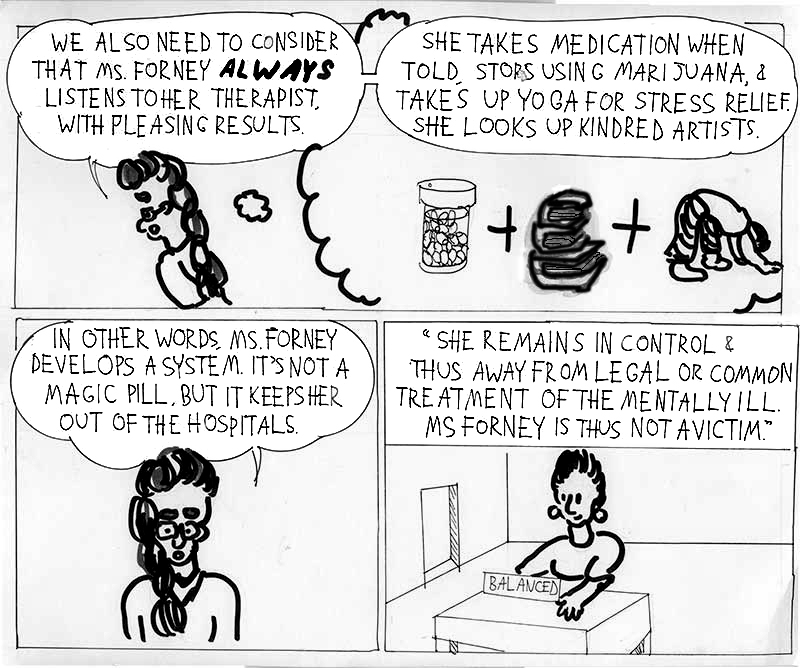
 Personally, I believe that having a doctor for a parent makes the difference. Pediatricians know firsthand what mind-altering medications will do to children, and thus take steps towards prevention rather than treatment.

Personally, I believe that having a doctor for a parent makes the difference. Parents fret about their kids constantly, and medical problems can be tremendous obstacles for well-intentioned mothers and fathers. Pediatricians know firsthand what mind-altering medications will do to children, and thus take steps towards prevention rather than treatment. That said, parents should do what they can to learn about the diagnoses, and not accept professionals’ words of final. I speak from experience, having mother who is a retired pediatrician.

 As an addendum, however, Ms. Forney does not represent every bipolar cartoonist. She happens to be a successful one, and talented at that,
As an addendum, however, Ms. Forney does not represent every bipolar cartoonist or artist. She happens to be a successful one, and talented Eisner winner. As an added irony to the law-abiding Keri and Dr. Saks, Ms. Forney has done recreational drugs and never had to enter rehab.


Conclusion
Despite the government's good intentions, parents and mentally ill children do not receive enough support from the laws or from the medical system. Senators and representatives lack awareness that the legal wording strips patients of their humanity, so that they appear burdensome and animals when compared to “sane” individuals. Yale-New Haven Hospital has not changed its policy regarding involuntary confinement, and California still has strict laws about the 72 Hour Hold and conservatorship. Law for other states allows for confinement based on a designated expert’s word, as well as for a week-long hospital stay without compromise. Patients and their parents have to fight for the ability to discuss treatment, while parents have to deal with the fact that their child suffers the mental illness label for life.  


Parents and independent adults diagnosed with bipolar or schizophrenia, need to find compromise between a psychiatrist’s label and the need to live an individual, liberated life. Ellen Forney and Dr. Elyn Saks found that balance by channeling their psychoses into creative and law-changing work, talking to licensed therapists who respected their choices, as well as finding family and friends who would support them through delusions and episodes. Parents want their children to succeed as artists, professionals, or as plain old human beings, and doctors labeling illnesses as “hopeless” does not respect those wishes. We need to change the laws to identify parents rather than “conservators” and treatment rather than “detention”; unless a mentally ill person resorts to the rare case of violence, they need help as opposed to imprisonment. In addition, we need to recognize small communities coming together to help one beloved, valuable individual. A mentally ill child is still a child, and they need assistance with growing up. If the law won’t help with that necessary growth, then individuals need to step in and offer compassion. It takes a village to raise a child, and allow them to become actual adults.